Friday, February 21, 2020

Rio de Janeiro at Carnival time

We have arrived at the port of Rio de Janeiro on the first day of Carnival, a festival held every year during the 5 days before Ash Wednesday.  It is considered the biggest Carnival in the world with an estimated 2 million people on the streets every day.

There was a four hour delay in clearing the ship at the port.  We were told that the health officials were "reviewing paper work."  This was not surprising in light of all the news about infections on cruise ships.  Finally we were deemed healthy and we left on a tour of the city and trip to Sugarloaf mountain.

The area near the port is known as "little Africa".  Africans were enslaved in Brazil for over three hundred years.  In 1888, the second emperor abolished slavery. The African influence is still reflected in the colourful Brazilian culture. The Portuguese influence is still apparent in the city's architecture and language. Hundreds of thousands of Portuguese immigrants found prosperity in Rio.  The Portuguese Royal Family lived here during the time of the Napoleonic wars.

Rio de Janeiro is the second largest city with a population of 7 million people.  It was the capital at one time, but in 1960 the ultra modern city of Brasilia was established as the capital. The city is laid out around Guanabara Bay, which is lined with the iconic beaches of Copacabana,  Iponema and Leblond.

Inland from the beaches, granite mountain peaks encircle the city.  "Christ the Redeemer" is a 40 metre (130 foot) tall statue atop Corcovado Mountain embracing the city with open arms. It was very cloudy the day we visited. Christ the Redeemer was in the clouds in the distance.


Sugarloaf rises from the water's edge and is visible from all over the city. Glass paneled cable cars run up to the summit at 396 m (1,299 feet). In the 16th century, sugar was shipped from Brazil in conical clay molds - hence the name of this granite peak.


As we returned to the ship in late afternoon, we could see the preparations for Carnival celebrations beginning.  People in colourful costumes were gathering the streets.

 We did not choose to attend the huge celebration at the Sambadrome exhibition centre.  We look forward to hearing about it from the large group who left at 9:00 p.m. in the pouring rain to be part of the crowd of thousands.

Thursday, February 20, 2020

First Stop in Brazil

After two days at sea, we have arrived at the port of Ilhabela on the island of Sao Sebastiao. Brazil is the 5th largest country in the world and borders on all South American countries except Ecuador and Chile. After discovery by Americo Vespucio in 1502, the earliest settlements were military outposts to protect the island from raids by buccaneers who waited offshore for English, Dutch and Portuguese ships. The Portuguese established sugar and coffee plantations in the 17th and 18th centuries.


Much of the island's rainforest is protected, home to ocelots, several species of primates, birds and butterflies.  The Cabras Marine Sanctuary preserves the home of colourful coral, an abundance of sea life, and underwater shipwrecks.  Multiple white sand beaches circle the island.  The 80 miles of coastline, calm waters and strong winds give Ilhabela the reputation as Brazil's "National Capital of Sailing."

We took a van trip to the Toca Waterfalls located on an old sugar cane plantation.  The three main cascading waterfalls drop 52 metres (164 ft).


The temperature was 27 C (80 F) and very humid.  After returning to the town centre,  we walked along the waterfront in search of cold beer. 


Monday, February 17, 2020

Montevideo, Uruguay

Nestled between the two giant countries, Brazil and Argentina, Uruguay is the second smallest country in South America.  More than half of the nation's population of 3 million resides in the capital city of Montevideo.

The indigenous peoples were conquered by the Spaniards, followed by the Portuguese, British, French, Spanish again until finally taking advantage of the distraction of wars in Europe, Uruguay declared independence in 1825. 

The arch in the Plaza Independencia marks the remains of the wall which surrounded the old city. An epic bronze monument on a granite base of a 19th century pioneer wagon drawn by oxen was created by local sculptor Jose Belloni.

Eighty per cent of the country's economy is based on farming. Exports include beef, leather, wool, dairy products, wine, caviar, soy, wheat, rice, fruits and vegetables.


Carlos Ott, a Uruguayan architect, who lives in Canada, is known for his design of sweeping structures of steel and glass.  His tower in Montevideo is reminiscent of the one in Dubai.


 At the Port Market, local artisans sell their wares while fine cuts of beef are cooked over an open flame. We could not resist a taste for lunch at a cost of about $20 US.


Uruguay was a neutral country during World War II.  However, the first major naval battle was the Battle of the River Plate between three Royal Navy cruisers and the German pocket battleship Admiral Graf Spee. The German ship was damaged and scuttled in the harbour.  Its anchor stands as a monument at the entrance to the port from the city.

It was an enjoyable day in Montevideo.  Our tour guide gave her insight into the political and economic challenges in the country.  We are realizing how very ignorant we are of the history and current events of these countries we are visiting.


Sunday, February 16, 2020

Buenos Aires

Today we toured Buenos Aries by bus with an wonderful guide, Paolo.  We appreciated the air conditioning in the bus as the temperature reached 27 C (82 F) and the humidity was high. 
Our first stop was Plaza de Mayo located at the spot where the city was founded. On the way we passed the Colon Theater which has been recognized as the third best opera house in the world.
Since the revolution of May 25, 1810 that led to Argentine's independence, this city square with the Casa Rosada presidential palace has played a pivotal role in the politics of Buenos Aires.  On this balcony, Juan and Eva Peron addressed the crowds.  Opinions of the Perons are varied - he was a dictator but she is known for her support for the working classes.
Facing the plaza is the cathedral where the current pope, Francis, was bishop.


The floor of the cathedral is inlaid with mosaic depicting the passion flower - representing the Passion of Christ.


In the centre of the plaza is an obelisk erected in 1811 to celebrate Argentina's independence from Spain. The white stones inlaid in the walkway represent the white scarves worn by women protesters following the military coup of 1976.  At that time many dissenters simply disappeared. 

Our next stop was the historic neighbourhood of La Boca.  The multi-coloured houses, street vendors, and tango cafes give a European flavour to the street scene. On the way to our next stop we saw the Floralis Generica the United Nations Park. This steel and aluminum sculpture in a reflecting pool opens in the morning and closes in the evening.

Our final stop was Recoleta Cemetery containing 6400 architecturally diverse mausoleums. There we visited the black marble crypt of Eva "Evita" Peron.


Saturday, February 15, 2020

On the way to Buenos Aires

We are travelling up the coast of Argentina to the mouth of the Rio de la Platte, originally meaning the river to silver, as it led to silver mines.


When word of Incan gold reached Europe in 1512, Buenos Aires was just a stop over along the river. In 1536, Spanish colonizer Pedro de Mendoza originally named the city Nuestra Senora Santa Maria del Buen Aire, "Our Lady St. Mary of the Good Air". The settlers were forced away by attacks of indigenous people. The Spanish were more successful in establishing a quiet isolated town in the 1580's.


The cattle boom of the 1880's brought an influx of European settlers. Soon beautiful buildings with architecture reminiscent of Rome, Paris, and London lined impressive wide avenues.

Today the population of the greater metropolitain area is more than 15 million .


At 5:30 p.m. we docked at the newest of the three ports that have been established over the years.  It is very entertaining watching the shuttle buses that take everyone to the Terminal and seeing all the containers ready to load onto ships.


Thursday, February 13, 2020

Sea lions and Dinosaurs

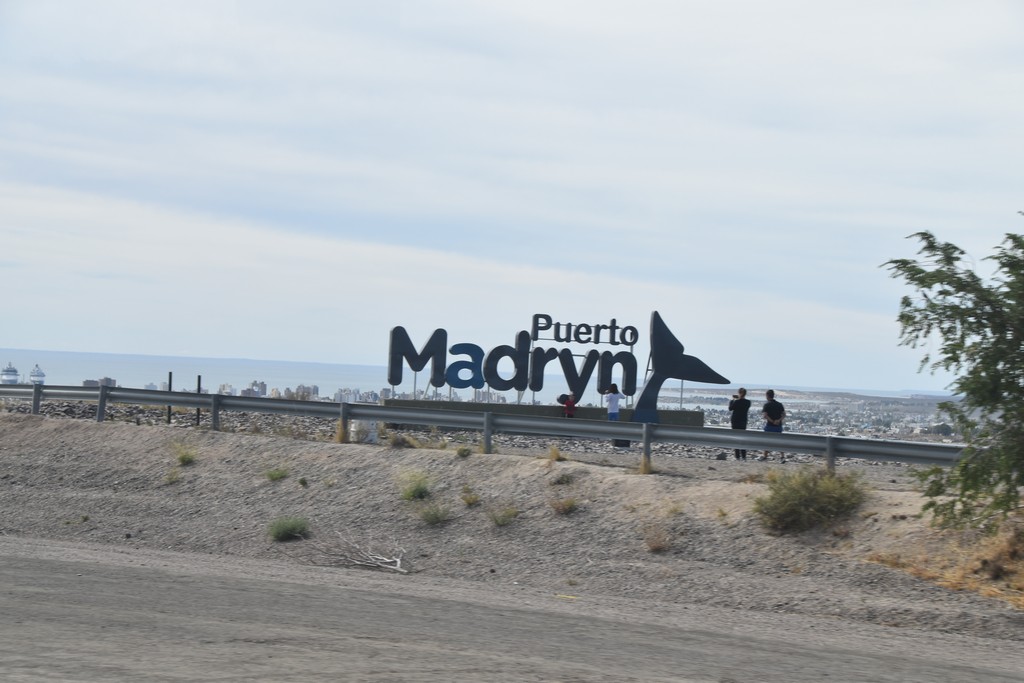
The coastal city of Puerto Madryn on the shores of a huge bay, Golfo Nuevo, was originally settled by 150 colonists from Wales in 1865.  They came here to farm after a promise of 100 square miles along the Chubut River.  It is now Argentina's second largest fishing port and home of the Aluar aluminum factory and other businesses.  It is also a major whale watching centre as over half of the world's southern right whale population inhabits these waters. It is also home to major colonies of sea lions, Magellanic penguins and other sea birds.


 The Welsh settlement is in the town of Trelew. Also located there is the Museum of Paleontology, a centre for scientific research. It has permanent and traveling exhibitions of fossil remains of flora and fauna of Patagonia dating back 400 million years.

Today we enjoyed sunny skies and a temperature of 17 C (63 F). Jack got to wear shorts for the first time this trip!


Tuesday, February 11, 2020

Free Rock Hopper beer in Stanley

We left Cape Horn and sailed for 24 hours to Stanley, the capital located on the tip of the East Falkland Island.  Because of the threat of impending stormy weather, all tours were cancelled but the shuttles were running.  Jack got to shore and realized he had not brought along his wallet.   A friendly fellow-passenger, seeing his sad face, invited him to a local watering hole for beer (actually 3 beers).
Thank you, Peanuts!

   Port Stanley was established in 1845 by the British as a deep water port specializing in repairs for boats travelling through Magellan Strait on their way to the California gold rush. Here one can see the world's most southern  Anglican cathedral.  The Whalebone Arch is made from the jaws of two blue whales. Along the shore, spelled out in rocks are the names of the patrol ships of the Royal Navy that have been stationed here to protect the sovereignty of the islands.


The economy of the islands depends on exportation of meat, wool, and fish and there are oil reserves.  Vegetables can be grown on the island but no fruit as there are no insects to pollinate the blossoms.

The Falklands War in 1982 was a 10 week undeclared war between Argentina and the United Kingdom. The United Kingdom government has consistently maintained that they continue to protect their interests in the islands because it is the will of the residents.  Lives were lost and clearing of land mines is ongoing by the British government.

War memorial 
Tribute to Prime Minister Margaret Thatcher


The Falklands teem with hundreds of species of flora and fauna.  Most notable are the penguin species - kings, rock hopper, gentoo, Magellan.  The rookeries are remote and can only be accessed by four wheel drive vehicles.  Some of the group of islands have no rats living on them.  Since rats eat eggs, the penguins number in the thousands.